Models run on the firm's own Agens Station. Documents, indexes, AI processing and audit logs never leave the firm. No public cloud AI, and no training data collection.
02
Unverified content can't get through
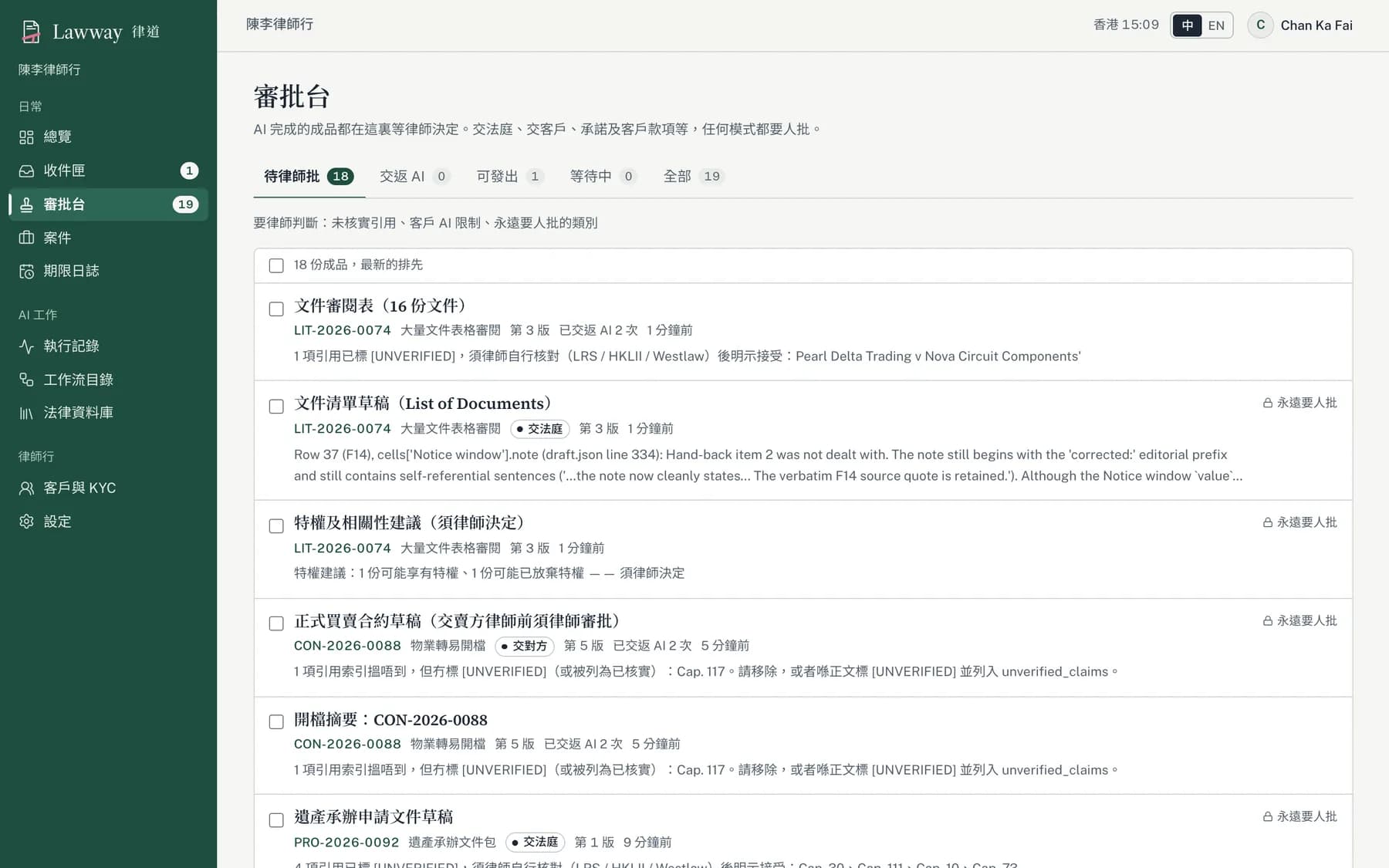
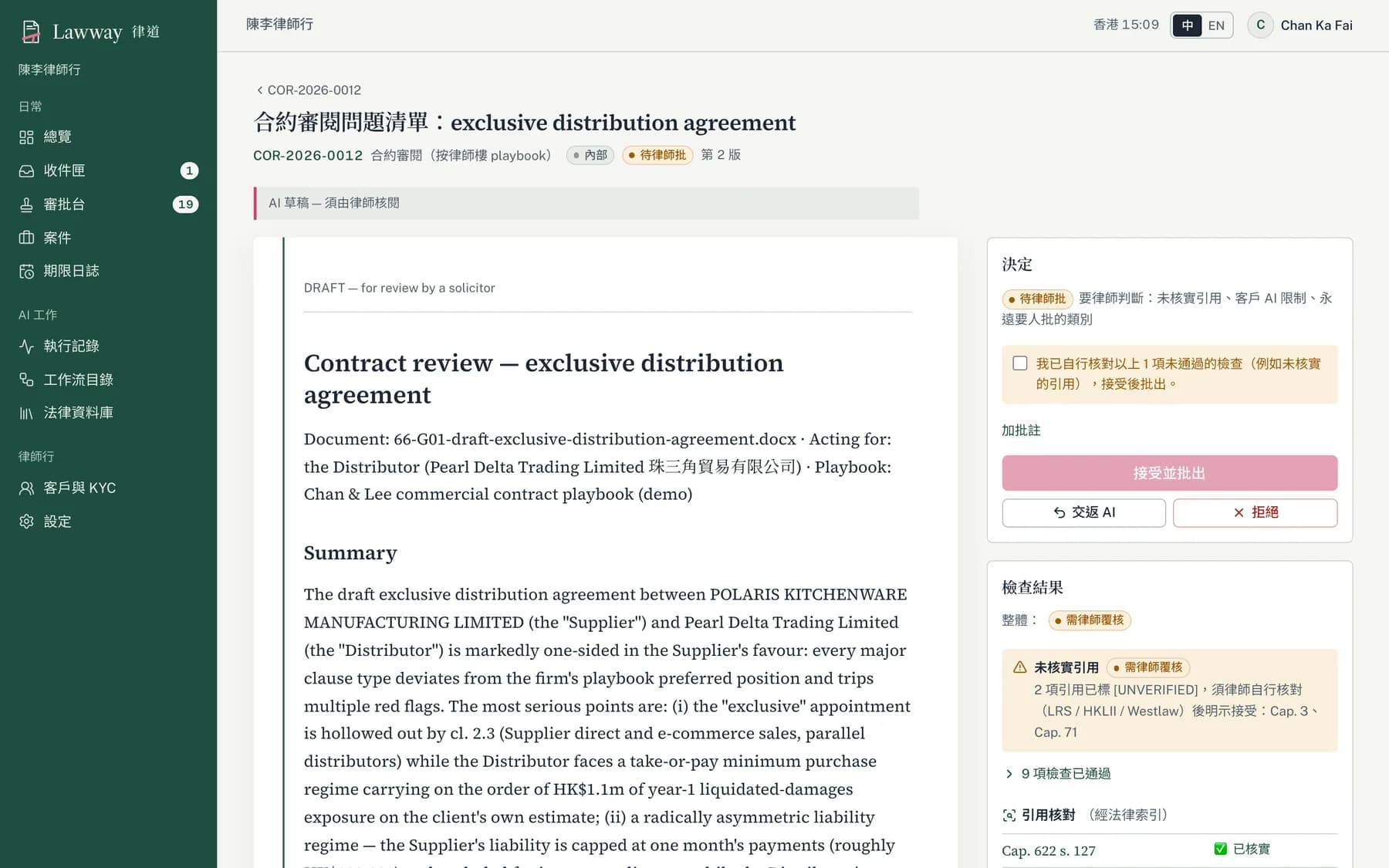
Every citation is checked against the legal index by code. Anything unverified is marked [UNVERIFIED] and cannot go out without a lawyer's explicit acceptance. The AI never does the arithmetic — code does.
03
Workflows, not a chatbot
An AI team plans, researches, drafts and checks its own work, a second AI reviews it, and then it goes to a lawyer for approval.
04
Solicitor and barrister work
Dedicated workflows from conveyancing, probate, family, employment, corporate and criminal work to counsel's opinions, pleadings and submissions.
05
Professional conduct built in
Anything filed, sent to a client, an undertaking, client money or a conflict clearance always needs a lawyer's sign-off. Clients who prohibit AI are blocked automatically.
06
Hong Kong bilingual legal documents
Traditional Chinese and English documents, deliverables and interface, with parallel bilingual drafts, a legal glossary and clause numbering preserved.
How a piece of work runs
Every job is a multi-step AI chain, and the last step is always a lawyer's approval.
1
Intake
Four entry points feed one inbox: console upload, a watched scanner folder, a dedicated intake mailbox and scheduled tasks. An AI clerk reads each document and suggests the matter it belongs to and the workflow to start.
2
Plan
The AI breaks the work into steps. Large jobs are split across several AIs working in parallel — one per legal issue or per document, for example.
3
Research and draft
The AI works only from the matter's documents and the legal index, citing with page references. Amounts, dates and stamp duty are calculated by code.
4
Self-check
Code checks citations, numbers and formatting. Anything that fails goes back to the AI to fix.
5
Second AI review
An independent reviewing AI checks the work again.
6
Lawyer approval
The deliverable goes to the review desk, where a lawyer approves it, edits it or sends it back.
7
Output
Once approved, code produces the DOCX, XLSX or PDF — for example, a paginated and indexed bundle.
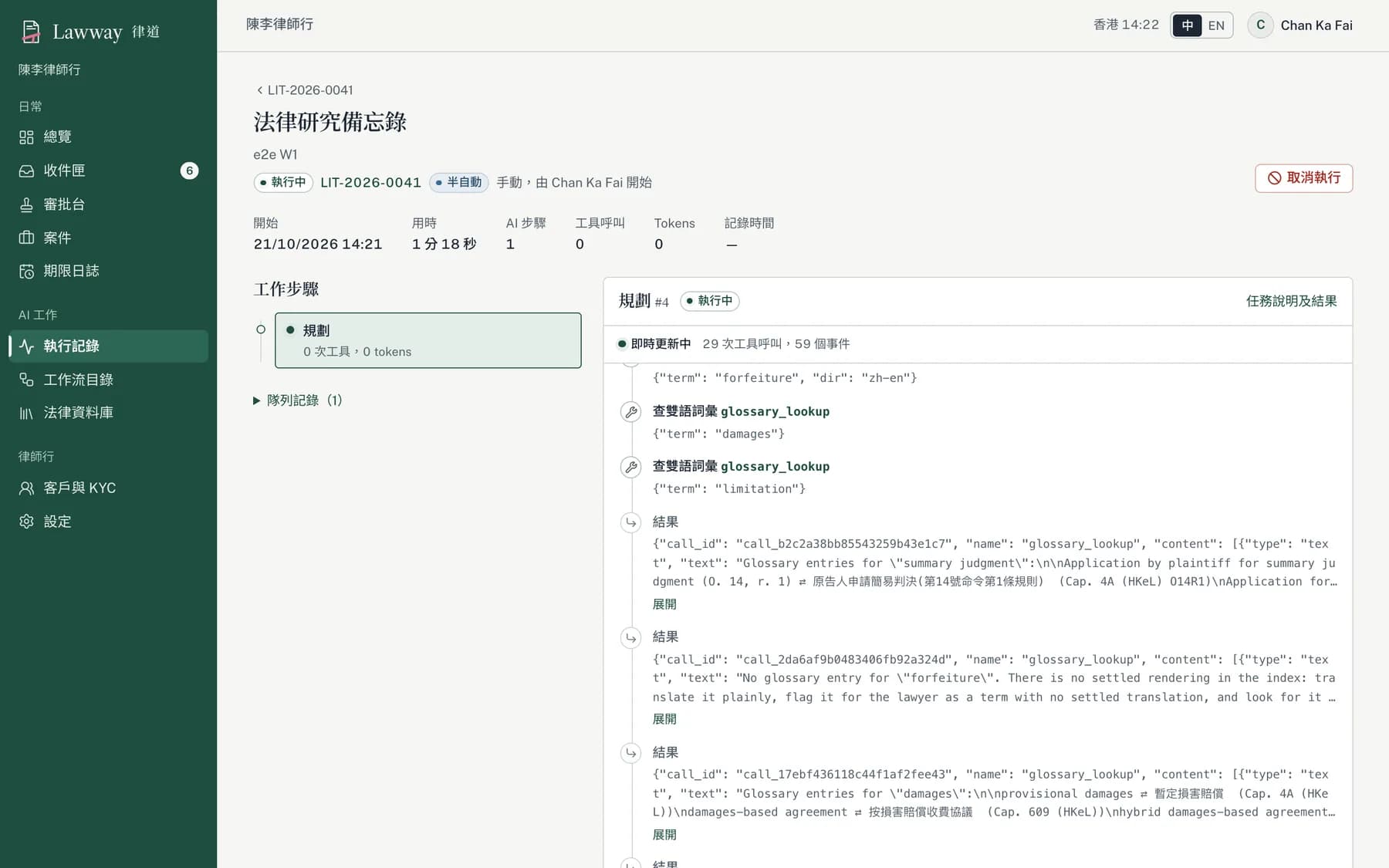
A run timeline. Demo data.
The AI has no tools to send, email, file or write to the database; it can only draft. Every step is visible live on the run timeline and recorded in the audit log.
From our internal tests
Internal tests, demo data
Accuracy of the "verified" label
0.766 → 1.000
After code verification was added, every citation labelled "verified" was confirmed against the index (small sample).
Unverified citations left unmarked
11/88 → 0/115
Every citation that couldn't be verified was marked [UNVERIFIED] (small sample).
End-to-end tests of core workflows
12 workflows, 163 AI runs, 0 failures
First round completed; every deliverable stopped on the review desk for a lawyer's approval.
Trap tests on new workflows
49/50, 95/96
Hit rate on planted traps across two rounds of new workflows.
What that looks like
A fictitious case, Wong Tai Sin Holdings v Lucky Star [2019] HKCFA 512, was marked [UNVERIFIED] and never used as authority.
A conflict of interest was caught automatically when a new matter was opened.
A client who prohibits AI was blocked: no AI step ran, and their documents never entered the index.
In a termination calculation, the system flagged that HR's proposal to offset fully against MPF does not comply with current law.
A hearing-date clash was caught when a barrister's brief came in.
Internal tests, demo data
A contract review with an unverified citation flagged. Demo data.
Workflows
Lawway covers 38 categories of Hong Kong solicitor services and 19 of barrister services.
Solicitors
Barristers
Both
General
Legal research memoBoth
Issues researched in parallel, every citation checked
Contract reviewSolicitors
Clause by clause against the firm's playbook, risk-rated with suggested changes; NDA, SaaS, employment and distribution playbooks built in
Tabular document reviewSolicitors
Custom fields extracted from every document, each cell linked to its source
Statement of claim, defence, counterclaim, reply, points of claim in arbitration
Submissions packBoth
Written submissions, list of issues, list of authorities and bundle, draft order
AppealsBoth
Grounds of appeal, appeal submissions and appeal deadlines
Trial preparationBarristers
Review of the other side's documents, trial outline, cross-examination notes (no witness coaching)
Leave to apply for judicial reviewBoth
Form 86 and the three-month time limit
Settlement or mediation position paperBoth
Positions and settlement proposals
Expert report reviewBoth
Medical, engineering and other expert reports
Fee noteBarristers
Drafted from the brief's fee terms; needs counsel's approval and is never sent automatically
Briefing counsel through LawwayBoth
Firms send briefs to chambers through Lawway; counsel decides whether to accept
Deployment
Both options run entirely inside the firm. No data leaves the firm's network.
One box
One machine, zero cloud
Hardware
One Agens Station, running both the models and Lawway
Best for
Firms of about 15 lawyers or fewer, and barristers' chambers
How lawyers use it
Sign in to the Lawway console in a browser
Maintenance
Remote updates and maintenance by Blockway: off by default, only with the firm's approval, all recorded in the audit log
Two boxes
More work in parallel, maintenance without interruption
Hardware
An Agens Station plus a separate Lawway host
Best for
Larger firms
How lawyers use it
Sign in to the Lawway console in a browser
Maintenance
Remote updates and maintenance by Blockway: off by default, only with the firm's approval, all recorded in the audit log
Hardware is sized to the firm, and it can be installed on a network isolated from the internet. The Station sends Blockway only operational data (health and usage); the system technically refuses document content and client data.
See Lawway at work
Tell us about your firm and the work you'd like to hand to an AI team. We'll walk you through it and set up a time-limited demo account for you.